
Let
be the statement “It looks like I’m laughing,” and let
be the statement “I’m really just asking to leave this alone.” Translate the logical statement

This matches a line from “The Sharpest Lives” by My Chemical Romance.

Context: Part of a discrete mathematics course includes an introduction to predicate and propositional logic for our math majors. As you can probably guess from their names, students tend to think these concepts are dry and uninteresting even though they’re very important for their development as math majors.
In an effort to making these topics more appealing, I spent a few days mining the depths of popular culture in a (likely futile) attempt to make these ideas more interesting to my students. In this series, I’d like to share what I found. Naturally, the sources that I found have varying levels of complexity, which is appropriate for students who are first learning prepositional and predicate logic.
When I actually presented these in class, I either presented the logical statement and had my class guess the statement in actual English, or I gave my students the famous quote and them translate it into predicate logic. However, for the purposes of this series, I’ll just present the statement in predicate logic first.
 be the set of all men, and let
  be the statement “
 likes to watch the world burn.” Translate the logical statement
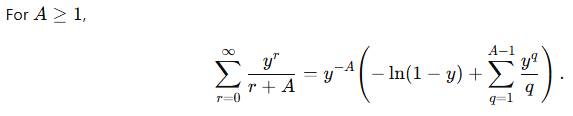
 is
is ,
,


![\displaystyle \sum_{r=0}^\infty \frac{y^{r}}{r+A} = \frac{1}{y^A} \left[ -\ln(1-y) - \sum_{q=1}^{A-1} \frac{y^q}{q} \right]](https://s0.wp.com/latex.php?latex=%5Cdisplaystyle+%5Csum_%7Br%3D0%7D%5E%5Cinfty+%5Cfrac%7By%5E%7Br%7D%7D%7Br%2BA%7D+%3D+%5Cfrac%7B1%7D%7By%5EA%7D+%5Cleft%5B+-%5Cln%281-y%29+-+%5Csum_%7Bq%3D1%7D%5E%7BA-1%7D+%5Cfrac%7By%5Eq%7D%7Bq%7D+%5Cright%5D&bg=ffffff&fg=000000&s=0&c=20201002)

 ,
, ,
, with
with  , we find
 , or
, or  . Therefore,

 by
by  , we obtain
 (since we are guaranteed that
  if
if 

 .
.


 ,
, . We now prove this combinatorical identity.
 , then
  .
. , then

![\displaystyle = 1 + \sum_{s=1}^a (-1)^s \left[\binom{n-1}{s-1} + \binom{n-1}{s}\right]](https://s0.wp.com/latex.php?latex=%5Cdisplaystyle+%3D+1++%2B+%5Csum_%7Bs%3D1%7D%5Ea+%28-1%29%5Es+%5Cleft%5B%5Cbinom%7Bn-1%7D%7Bs-1%7D+%2B+%5Cbinom%7Bn-1%7D%7Bs%7D%5Cright%5D+&bg=ffffff&fg=000000&s=0&c=20201002)


![\displaystyle = (-1)^a \binom{n-1}{a} +\sum_{s=1}^{a-1} \left[(-1)^{s+1} \binom{n-1}{s} + (-1)^s \binom{n-1}{s} \right]](https://s0.wp.com/latex.php?latex=%5Cdisplaystyle+%3D+%28-1%29%5Ea+%5Cbinom%7Bn-1%7D%7Ba%7D+%2B%5Csum_%7Bs%3D1%7D%5E%7Ba-1%7D+%5Cleft%5B%28-1%29%5E%7Bs%2B1%7D+%5Cbinom%7Bn-1%7D%7Bs%7D+%2B+%28-1%29%5Es+%5Cbinom%7Bn-1%7D%7Bs%7D+%5Cright%5D&bg=ffffff&fg=000000&s=0&c=20201002)
![\displaystyle = (-1)^a \binom{n-1}{a} + \sum_{s=1}^{a-1} (-1)^s \binom{n-1}{s} \left[ -1 + 1 \right]](https://s0.wp.com/latex.php?latex=%5Cdisplaystyle+%3D+%28-1%29%5Ea+%5Cbinom%7Bn-1%7D%7Ba%7D+%2B+%5Csum_%7Bs%3D1%7D%5E%7Ba-1%7D+%28-1%29%5Es+%5Cbinom%7Bn-1%7D%7Bs%7D+%5Cleft%5B+-1+%2B+1+%5Cright%5D&bg=ffffff&fg=000000&s=0&c=20201002)


 .
. on the
  ).
).
 , which is negative the number to the “northeast” of 10.
  , which is the number northeast of 45.
 , which is negative the number northeast of 120.
 , which is the number northeast of 210.
  .
. to emphasize that I haven’t proven that this equality is true. To be honest, I didn’t immediately believe that this worked; however, I was psychologically convinced after using Mathematica to compute this sum for about a dozen values of
  , then
 ,
, . I tried replacing


 :
:

 :
: .
.
 to integrate the left-hand side term-by-term:
 in it. Let’s also convert that to its Taylor series expansion and then use the formula for multiplying two infinite series:

 ,
, ,
, .
. to
to  was true. However, after using Mathematica to evaluate this sum for about a dozen different values of
  ,
, is
is .
.![\displaystyle \frac{z^a e^{-z}}{a} M(1, 1+a, z) = \displaystyle \frac{z^a e^{-z}}{a} \left[1 + \sum_{s=1}^\infty \frac{1 \cdot 2 \cdot \dots \cdot s}{(a+1)(a+2)\dots (a+s)} \frac{z^s}{s!} \right]](https://s0.wp.com/latex.php?latex=%5Cdisplaystyle+%5Cfrac%7Bz%5Ea+e%5E%7B-z%7D%7D%7Ba%7D+M%281%2C+1%2Ba%2C+z%29+%3D+%5Cdisplaystyle+%5Cfrac%7Bz%5Ea+e%5E%7B-z%7D%7D%7Ba%7D+%5Cleft%5B1+%2B+%5Csum_%7Bs%3D1%7D%5E%5Cinfty+%5Cfrac%7B1+%5Ccdot+2+%5Ccdot+%5Cdots+%5Ccdot+s%7D%7B%28a%2B1%29%28a%2B2%29%5Cdots+%28a%2Bs%29%7D+%5Cfrac%7Bz%5Es%7D%7Bs%21%7D+%5Cright%5D&bg=ffffff&fg=000000&s=0&c=20201002)
![= \displaystyle \frac{z^a e^{-z}}{a} \left[1 + \sum_{s=1}^\infty \frac{1}{(a+1)(a+2)\dots (a+s)} z^s \right]](https://s0.wp.com/latex.php?latex=%3D+%5Cdisplaystyle+%5Cfrac%7Bz%5Ea+e%5E%7B-z%7D%7D%7Ba%7D+%5Cleft%5B1+%2B+%5Csum_%7Bs%3D1%7D%5E%5Cinfty+%5Cfrac%7B1%7D%7B%28a%2B1%29%28a%2B2%29%5Cdots+%28a%2Bs%29%7D+z%5Es+%5Cright%5D&bg=ffffff&fg=000000&s=0&c=20201002)
![= \displaystyle \frac{z^a e^{-z}}{a} \left[1 + \sum_{s=1}^\infty \frac{a!}{(a+s)!} z^s \right]](https://s0.wp.com/latex.php?latex=%3D+%5Cdisplaystyle+%5Cfrac%7Bz%5Ea+e%5E%7B-z%7D%7D%7Ba%7D+%5Cleft%5B1+%2B+%5Csum_%7Bs%3D1%7D%5E%5Cinfty+%5Cfrac%7Ba%21%7D%7B%28a%2Bs%29%21%7D+z%5Es+%5Cright%5D&bg=ffffff&fg=000000&s=0&c=20201002)

 .
.![\displaystyle \frac{d}{dz} \left[\frac{z^a e^{-z}}{a} M(1, 1+a, z) \right] = \displaystyle \frac{d}{dz} \left[ e^{-z} \sum_{s=0}^\infty \frac{(a-1)!}{(a+s)!} z^{a+s} \right]](https://s0.wp.com/latex.php?latex=%5Cdisplaystyle+%5Cfrac%7Bd%7D%7Bdz%7D+%5Cleft%5B%5Cfrac%7Bz%5Ea+e%5E%7B-z%7D%7D%7Ba%7D+M%281%2C+1%2Ba%2C+z%29+%5Cright%5D+%3D+%5Cdisplaystyle+%5Cfrac%7Bd%7D%7Bdz%7D+%5Cleft%5B+e%5E%7B-z%7D+%5Csum_%7Bs%3D0%7D%5E%5Cinfty+%5Cfrac%7B%28a-1%29%21%7D%7B%28a%2Bs%29%21%7D+z%5E%7Ba%2Bs%7D+%5Cright%5D&bg=ffffff&fg=000000&s=0&c=20201002)
![= -e^{-z} \displaystyle \sum_{s=0}^\infty \frac{(a-1)!}{(a+s)!} z^{a+s} + e^{-z} \frac{d}{dz} \left[ \sum_{s=0}^\infty \frac{(a-1)!}{(a+s)!} z^{a+s} \right]](https://s0.wp.com/latex.php?latex=%3D+-e%5E%7B-z%7D+%5Cdisplaystyle+%5Csum_%7Bs%3D0%7D%5E%5Cinfty+%5Cfrac%7B%28a-1%29%21%7D%7B%28a%2Bs%29%21%7D+z%5E%7Ba%2Bs%7D+%2B+e%5E%7B-z%7D+%5Cfrac%7Bd%7D%7Bdz%7D+%5Cleft%5B++%5Csum_%7Bs%3D0%7D%5E%5Cinfty+%5Cfrac%7B%28a-1%29%21%7D%7B%28a%2Bs%29%21%7D+z%5E%7Ba%2Bs%7D+%5Cright%5D&bg=ffffff&fg=000000&s=0&c=20201002)


 .
.![\displaystyle \frac{d}{dz} \left[\frac{z^a e^{-z}}{a} M(1, 1+a, z) \right] =-e^{-z} \sum_{s=1}^\infty \frac{(a-1)!}{(a+s-1)!} z^{a+s-1} + e^{-z} \sum_{s=0}^\infty \frac{(a-1)!}{(a+s-1)!} z^{a+s-1}](https://s0.wp.com/latex.php?latex=%5Cdisplaystyle+%5Cfrac%7Bd%7D%7Bdz%7D+%5Cleft%5B%5Cfrac%7Bz%5Ea+e%5E%7B-z%7D%7D%7Ba%7D+M%281%2C+1%2Ba%2C+z%29+%5Cright%5D+%3D-e%5E%7B-z%7D+%5Csum_%7Bs%3D1%7D%5E%5Cinfty+%5Cfrac%7B%28a-1%29%21%7D%7B%28a%2Bs-1%29%21%7D+z%5E%7Ba%2Bs-1%7D+%2B+e%5E%7B-z%7D+%5Csum_%7Bs%3D0%7D%5E%5Cinfty+%5Cfrac%7B%28a-1%29%21%7D%7B%28a%2Bs-1%29%21%7D+z%5E%7Ba%2Bs-1%7D&bg=ffffff&fg=000000&s=0&c=20201002) .
. = e^{-z} z^{a-1}$
![\displaystyle \frac{d}{dz} \left[\frac{z^a e^{-z}}{a} M(1, 1+a, z) \right] = \frac{e^{-z} z^{a-1}}{a}](https://s0.wp.com/latex.php?latex=%5Cdisplaystyle+%5Cfrac%7Bd%7D%7Bdz%7D+%5Cleft%5B%5Cfrac%7Bz%5Ea+e%5E%7B-z%7D%7D%7Ba%7D+M%281%2C+1%2Ba%2C+z%29+%5Cright%5D+%3D+%5Cfrac%7Be%5E%7B-z%7D+z%5E%7Ba-1%7D%7D%7Ba%7D&bg=ffffff&fg=000000&s=0&c=20201002) .
.![\displaystyle \int_0^z t^{a-1} e^{-t} \, dt = \left[\frac{t^a e^{-t}}{a} M(1, 1+a, t) \right]_0^z](https://s0.wp.com/latex.php?latex=%5Cdisplaystyle+%5Cint_0%5Ez+t%5E%7Ba-1%7D+e%5E%7B-t%7D+%5C%2C+dt+%3D+%5Cleft%5B%5Cfrac%7Bt%5Ea+e%5E%7B-t%7D%7D%7Ba%7D+M%281%2C+1%2Ba%2C+t%29+%5Cright%5D_0%5Ez&bg=ffffff&fg=000000&s=0&c=20201002)

 .
. Mean Green Math